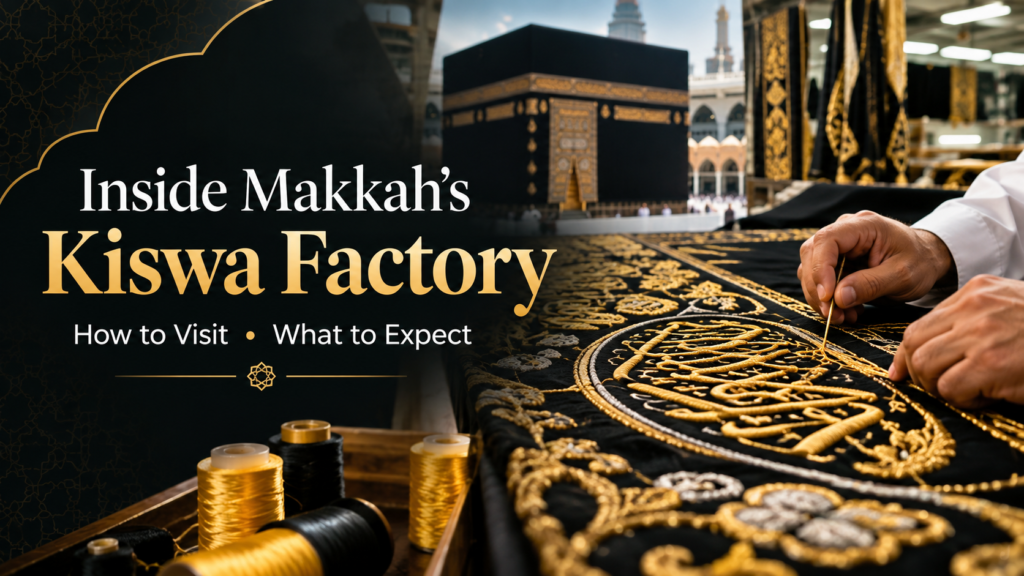
Planning to visit the Kiswa Factory in Makkah during your Umrah trip? The King Abdulaziz Complex for the Holy Kaaba Kiswa is one of the most fascinating places to explore in Makkah for visitors interested in Islamic history, Arabic calligraphy, traditional craftsmanship, and the story behind the beautiful black covering of the Kaaba.
Moreover, a visit to the Kiswa Complex allows pilgrims to see how the Kiswa is prepared using natural silk, weaving, printing, embroidery, sewing, and gold- and silver-thread craftsmanship. In fact, the Saudi Press Agency reported in 2026 that the production process includes seven carefully controlled stages, combining modern technology with skilled craftsmanship.
However, visiting the Kiswa Factory is not the same as visiting a normal tourist attraction. Access arrangements, visitor schedules, security requirements, and tour availability can change. Therefore, pilgrims should confirm the latest official arrangements before making the journey.
In this complete 2026 guide, you will learn:
- What the Kiswa Factory is
- Where the Kiswa Factory is located
- How to reach it from Masjid al-Haram
- How Kiswa visits are arranged
- What you can see inside
- How the Kiswa is manufactured
- Important Kiswa facts and figures
- The latest information about the annual Kiswa replacement
- What to wear
- Photography and visitor etiquette
- How to arrange private transportation
- Frequently asked questions
Quick Answer: How Can You Visit the Kiswa Factory in Makkah?
The Kiswa Factory, officially known as the King Abdulaziz Complex for the Holy Kaaba Kiswa, is located in the Umm Al-Joud area of Makkah.
Generally, access to the complex is arranged through authorized programs, official invitations, organized visits, or approved visitor arrangements rather than simply treating it as an unrestricted walk-in attraction.
Therefore, if you want to visit during your Umrah journey, check the latest official visitor arrangements before travelling to the complex.
The factory is approximately a short drive from central Makkah. However, travel time can vary considerably because of traffic, especially during Ramadan, Hajj, weekends, and busy Umrah periods.
For the latest official information about the complex and activities related to the Two Holy Mosques, check Saudi official announcements before your trip.
Saudi Press Agency : Official Saudi Updates
Quick Facts About the Kiswa Factory
| Information | 2026 Guide |
| Official name | King Abdulaziz Complex for the Holy Kaaba Kiswa |
| Arabic name | مجمع الملك عبدالعزيز لكسوة الكعبة المشرفة |
| Location | Umm Al-Joud, Makkah |
| Main purpose | Manufacturing the Kiswa of the Holy Kaaba |
| Kiswa material | Natural silk |
| Main exterior colour | Black |
| Inner Kiswa | Green |
| Embroidery | Gold-plated silver and silver threads |
| Calligraphy | Arabic calligraphy, including Thuluth Jali |
| Production | Year-round |
| Major processes | Dyeing, weaving, printing, embroidery, sewing and assembly |
| Kiswa panels | 47 panels |
| Kiswa height | Approximately 14 metres |
| 2026 Kiswa weight | Approximately 1,415 kg |
| Natural silk used for the 2026 Kiswa | Approximately 825 kg |
| Gold-plated silver thread | Approximately 120 kg |
| Pure silver | Approximately 60 kg |
| Craftsmen involved | Around 150 skilled Saudi artisans reported for the 1448 AH Kiswa |
| Kiswa replacement | Annually at the beginning of Muharram |
| Current location of complex | Umm Al-Joud, Makkah |
Importantly, some older online articles quote different measurements and material quantities. For example, older sources commonly mention figures such as 850–1,000 kg for the Kiswa. The official 2026 reporting gives the new Kiswa’s weight as approximately 1,415 kg, with 825 kg of natural silk, 120 kg of gold-plated silver thread and 60 kg of pure silver.
Therefore, travellers should use the latest official figures rather than relying on older travel blogs.
What Is the Kiswa Factory?
The Kiswa Factory is the specialized complex responsible for producing the covering of the Holy Kaaba.
The official name is the King Abdulaziz Complex for the Holy Kaaba Kiswa.
Essentially, the complex brings together traditional Islamic textile craftsmanship, Arabic calligraphy, embroidery, weaving and modern production technology.
The Kiswa is not simply a large piece of black cloth.
Instead, it is a highly complex textile artwork containing carefully designed Arabic calligraphy, Quranic verses, Islamic motifs, embroidered elements and a large belt surrounding the upper section of the Kaaba.
Saudi official reporting in 2026 described the Kiswa as an important expression of Islamic art and Arabic calligraphy, with Quranic verses and expressions of faith embroidered using gold and silver threads.
As a result, the factory represents both a religious heritage institution and a highly specialized manufacturing facility.
Where Is the Kiswa Factory Located?
The King Abdulaziz Complex is located in Umm Al-Joud, Makkah.
The complex moved to its present Umm Al-Joud premises in 1397 AH, where it was equipped with advanced machinery and integrated production departments.
Because the factory is outside the immediate Masjid al-Haram area, arranging reliable transportation is particularly important for pilgrims staying around the Haram.
How Far Is the Kiswa Factory From Masjid al-Haram?
The exact driving distance depends on your starting point and route.
Generally, the journey from the central Haram area requires a private vehicle or taxi.
Furthermore, journey times can change significantly during:
- Ramadan
- Hajj season
- Friday prayers
- Busy Umrah periods
- Evening traffic
- Road diversions
- Major events around Makkah
Therefore, do not plan your journey based solely on a fixed number of minutes.
Instead, allow additional time for traffic and security procedures.
How to Reach the Kiswa Factory From Masjid al-Haram
There are several practical transportation options.
1. Private Taxi
A private taxi is one of the simplest options for pilgrims staying in Makkah.
For example, you can arrange a vehicle from your hotel and travel directly to the complex.
However, make sure the driver understands that you are visiting the King Abdulaziz Complex for the Holy Kaaba Kiswa in Umm Al-Joud, rather than simply asking for a generic “Kiswa” location.
2. Private Car With Driver
For families and groups, a private vehicle can be more convenient.
In particular, this option is useful when:
- You are travelling with elderly pilgrims
- You have children
- You have a group
- You want the driver to wait
- You are visiting several Makkah landmarks
- You want hotel pickup and return
A private driver also reduces the problem of finding transportation after completing your visit.
3. Umrah City Tour
Alternatively, you can include the Kiswa Complex in a broader Makkah sightseeing or Ziyarat itinerary.
For example, your private Makkah tour could potentially combine suitable cultural and historical stops with transportation according to current access arrangements.
However, every attraction should be checked for current visitor access before the itinerary is finalized.
Book a Private Ride to the Kiswa Factory
If you are planning a Kiswa Complex visit, reliable transportation can make the experience much easier.
Umrah Taxi Traveler : Private Makkah Transportation
Moreover, private transportation is especially useful for families, elderly pilgrims, international visitors, and groups who prefer hotel-to-hotel service.
You can arrange transportation according to your itinerary, including:
- Makkah hotel pickup
- Kiswa Complex transfer
- Makkah Ziyarat transportation
- Return to your hotel
- Airport transfers
- Makkah to Madinah transfers
- Madinah to Makkah transfers
- Private family vehicles
- Group transportation
Therefore, instead of worrying about finding another taxi after your visit, you can plan your complete transportation schedule in advance.
What Can You See Inside the Kiswa Complex?
A visit to the Kiswa Complex can provide a fascinating look at the different stages involved in producing the Kaaba’s covering.
Importantly, access to individual production areas may depend on the type of visit, security arrangements, official visitor program and operational requirements.
Nevertheless, official reporting confirms that the complex contains specialized production processes involving silk preparation, dyeing, weaving, printing, embroidery and sewing.
Let’s look at the major stages.
Stage 1: Preparing the Silk
The process begins with high-quality natural silk.
First, the material must be prepared before it can become part of the Kiswa.
Then, the silk undergoes washing and dyeing processes.
According to official 2026 reporting, the washing process removes the wax coating from the silk, after which it is dyed black for the exterior Kiswa and green for internal applications.
As a result, the familiar deep-black appearance of the Kiswa begins long before the embroidery stage.
Stage 2: Dyeing the Silk
The exterior of Kiswa is famous for its deep black colour.
However, the colour is not simply applied for appearance.
The silk has to meet strict production requirements before it moves to the next stage.
In addition, the complex also produces green textile material used for interior applications.
The careful dyeing process ensures consistency throughout the large quantity of material required for the Kiswa.
Stage 3: Weaving
After preparation and dyeing, the silk enters the weaving stage.
During this stage, silk threads are transformed into the textile structure used to create the Kiswa panels.
Saudi official reporting in 2026 noted that automated weaving uses extremely dense thread arrangements, with more than 9,900 threads per metre in the relevant weaving process.
Therefore, the fabric is the result of highly precise textile engineering rather than ordinary cloth production.
Stage 4: Printing and Designing
Once the silk has been prepared, the design process begins.
Next, Quranic verses and Islamic motifs are applied to the fabric using precise printing techniques.
This stage helps establish the exact positioning of the embroidery and decorative elements.
In other words, the printing stage acts as an important guide for the highly detailed embroidery work that follows.
Stage 5: Embroidery
For many visitors, the embroidery department is one of the most fascinating aspects of the Kiswa-making process.
Here, skilled craftsmen work with gold-plated silver and silver threads.
The embroidery includes Quranic verses, Islamic motifs and Arabic calligraphy.
Moreover, calligraphy is not random decoration.
Saudi official sources report that the Kiswa uses the Thuluth Jali style of Arabic calligraphy for its Quranic inscriptions and decorative text.
Consequently, the Kiswa combines religious significance with an extremely sophisticated form of Islamic visual art.
Stage 6: Sewing and Assembly
After individual sections have been prepared, they must be joined together.
Then, the panels are assembled and the embroidered elements are attached.
The Kiswa consists of multiple large sections that must fit together accurately.
Because the covering will ultimately surround the Kaaba, accuracy at this stage is extremely important.
Stage 7: Final Quality Control
Finally, the completed Kiswa undergoes inspection and preparation before it is transported to the Grand Mosque.
The final stage ensures that the finished covering meets the required standards before installation.
In 2026, official reports described the production process as combining modern technology with specialized manual craftsmanship.
How Long Does It Take to Make the Kiswa?
The Kiswa is produced over a long production cycle.
According to official 2026 reporting, the Kiswa installed for the beginning of 1448 AH was produced through approximately a year-long process.
Furthermore, Saudi official reporting stated that around 150 skilled Saudi artisans contributed to its production.
Therefore, when you see the Kiswa during Tawaf, it represents months of planning, manufacturing, embroidery, assembly and quality control.#
How Much Does the Kiswa Weigh?
The latest official figures are particularly interesting.
The Kiswa installed for the beginning of 1448 AH in 2026 weighed approximately:
1,415 kilograms
It was produced using approximately:
- 825 kg of natural silk
- 120 kg of gold-plated silver thread
- 60 kg of pure silver
- Approximately 47 black-silk rolls/panels for the exterior covering
- Additional cotton used for the inner lining
Therefore, older articles quoting a weight of approximately 850 kg should not automatically be treated as the current 2026 specification.
How Many Panels Does the Kiswa Have?
The Kiswa consists of 47 embroidered black-silk panels.
In addition, the Kiswa includes the famous embroidered belt and other decorative components.
The belt contains Quranic inscriptions and is one of the most visually recognizable elements of the Kaaba’s covering.
Furthermore, the Kaaba’s door curtain is a separate and highly elaborate embroidered component.
What Is Written on the Kiswa?
The Kiswa contains Quranic verses and expressions of faith.
Moreover, these inscriptions are written using highly developed Arabic calligraphy.
The Thuluth Jali style is prominently used because of its suitability for large-scale decorative inscriptions and its elegant visual structure.
As a result, the Kiswa is not only a textile covering but also a monumental example of Arabic calligraphy.
When Is the Kiswa [Ghilaaf’e’Kahbaa] Changed?
This is an important point for anyone reading older travel blogs.
Previously, the annual Kiswa replacement was traditionally associated with the Day of Arafah during Hajj.
However, the replacement ceremony has been carried out at the beginning of Muharram in recent years.
The Kiswa was replaced on 1 Muharram 1447 AH, corresponding to 26 June 2025, and the 2026 replacement was also conducted at the beginning of the new Hijri year, 1448 AH.
Therefore, travellers should not rely on old articles stating that the Kiswa is always changed on 9 Dhul-Hijjah.
What Happened During the 2026 Kiswa Replacement?
The 2026 replacement operation began with preparations on 15 June 2026.
During the preparation, workers removed decorative elements, gold-embroidered components and the Kaaba door curtain before the old Kiswa was removed and the new Kiswa installed.
Meanwhile, the new Kiswa was transported from the King Abdulaziz Complex to Masjid al-Haram under a coordinated operational system.
Finally, the new Kiswa was installed at the beginning of Muharram 1448 AH.
This annual process demonstrates how closely the factory’s work is connected to the Holy Kaaba itself.
Is the Kiswa Factory a Museum or a Working Factory?
It is primarily a specialized production complex.
Therefore, visitors should not expect a conventional museum experience.
Instead, the complex demonstrates the manufacturing and craftsmanship associated with producing the Kiswa.
In addition, official visitor programs have included explanations of technical departments, production methods and the technologies used in manufacturing the Kiswa.
For example, an official July 2026 visitor program included a group of Umrah guests who learned about silk preparation, dyeing, weaving, embroidery and sewing.
Can Visitors Actually See the Craftsmen Working?
Yes, depending on the visitor program and areas made available during the visit.
Officially reported visits have included opportunities to observe technical and production departments.
However, access to active production areas can depend on operational, security and visitor-management arrangements.
Therefore, do not assume that every visitor will receive unrestricted access to every department.
The complex is an operational facility, not simply a tourist exhibition.
Can Visitors Touch or Stitch the Kiswa?
Normally, visitors should not touch production materials or equipment unless an authorized guide specifically permits it.
Interestingly, an official visitor program in July 2026 included a symbolic experience in which participants stitched part of the Kiswa.
However, this was part of a particular organized program and should not be interpreted as a standard activity available to every visitor.
Is Photography Allowed?
Photography policies can vary by area and visitor program.
Therefore, always follow the instructions of your guide and the staff at the complex.
In particular, do not photograph restricted production activities if staff instruct visitors not to do so.
Moreover, avoid using flash photography around sensitive textile or exhibition areas unless permission is given.
What Should You Wear to Visit the Kiswa Factory?
Because the Kiswa Complex is connected to the service of the Holy Kaaba, visitors should dress modestly and respectfully.
For Men
Suitable clothing includes:
- Thobe
- Long trousers and modest shirt
- Clean, respectable casual clothing
- Ihram if you are already performing Umrah and the visit fits your pilgrimage schedule
For Women
Suitable clothing includes:
- Abaya or modest outerwear
- Head covering
- Loose and respectful clothing
Above all, dress as you would when visiting a significant Islamic institution.
Can Families Visit the Kiswa Factory?
Family access depends on the current visitor program and admission conditions.
Therefore, families should confirm whether children are included in their particular approved visit before travelling.
In addition, elderly family members should be considered when planning transportation.
A private vehicle can be particularly helpful because it reduces unnecessary walking and waiting.
How Long Should You Plan for the Visit?
The actual visit duration depends on the visitor program.
Generally, you should allow additional time beyond the tour itself for:
- Hotel pickup
- Traffic
- Entry procedures
- Security
- Waiting
- The guided visit
- Return transportation
Therefore, do not schedule your Kiswa Complex visit immediately before another important appointment.
A comfortable itinerary gives you a buffer.
Best Time to Visit the Kiswa Factory
The best time depends on your travel schedule and official visitor availability.
Generally, morning visits can be easier to manage because they leave the rest of your day available for other activities.
However, traffic and official schedules can vary.
During Ramadan
Ramadan is one of the busiest periods in Makkah.
Therefore, transportation can take longer than expected.
During Hajj
Hajj season brings major operational changes throughout Makkah.
As a result, access to certain locations and visitor attractions may be restricted or managed differently.
During Regular Umrah Months
Outside peak periods, planning can be comparatively easier.
Nevertheless, always verify availability before travelling.
Can You Combine the Kiswa Factory With a Makkah Ziyarat Tour?
Yes, this can be a practical way to organize your day, provided each location is currently accessible.
For example, a private Makkah itinerary can be planned around cultural, historical and religious landmarks according to your interests and the current access rules.
Possible stops may include:
- Kiswa Complex
- Jabal Thawr area
- Hudaybiyah area
- Islamic historical sites
- Makkah museums or exhibitions
- Other officially accessible visitor locations
However, not every attraction is always open to visitors.
Therefore, your driver or tour provider should verify the itinerary before departure.
Why Private Transportation Is Better for a Kiswa Factory Visit
For individual pilgrims, public transportation can sometimes be sufficient.
However, private transportation offers several advantages.
1. Hotel Pickup
You don’t need to find transportation separately.
2. Direct Journey
The driver takes you directly to your destination.
3. Return Transportation
Your vehicle can remain part of your itinerary instead of leaving you searching for a taxi afterward.
4. Family Comfort
Families with children and elderly pilgrims can travel more comfortably.
5. Flexible Itinerary
You can potentially combine the Kiswa Complex with other suitable Makkah destinations.
6. Group Travel
Larger families can choose an appropriate vehicle rather than splitting into multiple taxis.
Therefore, private transportation is particularly useful for pilgrims who want a stress-free sightseeing experience.
Vehicles You Can Consider for Makkah Ziyarat
Depending on your group size, suitable transportation may include:
| Vehicle Type | Best For |
| Toyota Camry | Couples and small families |
| 7-Seater | Families and small groups |
| GMC Yukon XL | Families wanting more comfort and luggage space |
| Hyundai Staria | Families and medium groups |
| Toyota Hiace | Larger groups |
| Coaster | Group transportation |
In addition, your choice should depend on luggage, number of passengers, elderly travellers and the number of destinations planned.
For private Makkah transportation:
Book Makkah Transportation with Umrah Taxi Traveler
Important Tips Before Visiting the Kiswa Complex
1. Confirm Visitor Access First
This is the most important tip.
Do not simply arrive at the complex assuming you can enter.
Instead, confirm the current visitor arrangements and requirements.
2. Keep Your Identification With You
Furthermore, carry the identification or documentation required for your approved visit.
However, do not send sensitive identity documents to unofficial individuals or websites.
3. Arrive Early
Ideally, arrive with sufficient time before your scheduled visit.
Traffic in Makkah can be unpredictable.
Therefore, give yourself a reasonable buffer.
4. Arrange Your Return Ride
This is one of the most overlooked travel tips.
After completing your visit, you may not want to spend time searching for another vehicle.
Instead, arrange a private return vehicle in advance.
5. Respect the Workplace
Remember that the Kiswa Complex is a working production facility.
Therefore, follow staff instructions, remain respectful and avoid touching machinery or materials.
6. Do Not Rely on Old Blog Information
Kiswa production figures, replacement dates and visitor arrangements can change.
For example, the 2026 official figures differ from several older articles published online.
Therefore, always check the latest Saudi official announcements before travelling.
Interesting Facts About the Kiswa
Fact 1: The Kiswa Is Made Every Year
Unlike an ordinary historical artifact, a new Kiswa is produced annually.
Fact 2: The Kiswa Is Made in Makkah
Historically, Kiswa production was carried out outside Saudi Arabia during earlier periods.
However, Saudi-era production began in Makkah under King Abdulaziz, with the first Saudi Kiswa workshop established in Ajyad in 1346 AH.
Fact 3: The Factory Has Modern Technology
At the same time, traditional craftsmanship remains important.
The modern complex combines advanced machinery with specialized manual work.
Fact 4: Arabic Calligraphy Is Central to the Kiswa
Moreover, the Kiswa is one of the world’s most recognizable examples of monumental Arabic calligraphy.
The Thuluth Jali style is used for important inscriptions.
Fact 5: The Kiswa Requires Months of Work
In fact, the 2026 Kiswa was described by Saudi official sources as the result of a year-long production process.
Kiswa Factory Visit for International Umrah Pilgrims
For international pilgrims, visiting the Kiswa Complex can be especially meaningful.
For example, pilgrims from Pakistan, India, Bangladesh, Indonesia, Malaysia, the UK, USA, Canada and other countries may already be familiar with the Kiswa through photographs and television broadcasts.
However, seeing the craftsmanship behind it can make the experience much more personal.
Moreover, international pilgrims often prefer private transportation because they may be unfamiliar with Makkah’s roads and local transportation arrangements.
Therefore, arranging a trusted private vehicle can make the journey considerably easier.
Kiswa Factory Visit From Makkah Hotels
If you are staying in a Makkah hotel, your transportation plan can be simple:
Step 1: Confirm your approved visit arrangements.
Step 2: Confirm the location and expected arrival time.
Step 3: Book your private vehicle.
Step 4: Arrange hotel pickup.
Step 5: Travel to Umm Al-Joud.
Step 6: Complete security and visitor procedures.
Step 7: Take the authorized tour.
Step 8: Return to your hotel or continue your Makkah itinerary.
As a result, your visit becomes part of a structured day rather than an isolated trip.
Suggested Makkah Kiswa + Ziyarat Itinerary
Here is an example of how you could organize your day.
Morning
8:00 AM – 9:00 AM
Hotel pickup and departure.
Kiswa Complex
Visit according to your confirmed visitor schedule.
Late Morning
Return or continue to another officially accessible Makkah attraction.
Afternoon
Return to hotel for rest.
Evening
Visit Masjid al-Haram for prayer and worship.
However, the exact sequence should always be adjusted according to your approved visitor time, prayer schedule, traffic and attraction access.
Frequently Asked Questions About the Kiswa Factory
Is the Kiswa Factory open to visitors in 2026?
Yes, official organized visits to the King Abdulaziz Complex continue to take place in 2026. Saudi official reports documented visits by international media delegations and Umrah visitors during 2026.
However, visitor access is subject to current official arrangements.
Where is the Kiswa Factory in Makkah?
The King Abdulaziz Complex is located in the Umm Al-Joud area of Makkah.
Therefore, it requires transportation from the central Haram area.
Can I simply walk into the Kiswa Factory?
Do not assume that walk-in access is available.
Instead, confirm the current visitor procedure before travelling.
Is there a fixed daily opening time?
Visitor schedules can change according to official arrangements, operational requirements, seasons and organized programs.
Therefore, older websites listing fixed daily hours should be treated cautiously.
Can tourists visit the Kiswa Factory?
Muslim visitors in Makkah may be able to visit through approved visitor arrangements.
However, the complex is not simply an unrestricted tourist attraction, so current access should be confirmed before planning the trip.
Can children visit the Kiswa Factory?
Children’s access depends on the current visitor program and rules.
Therefore, families should confirm age requirements before booking or travelling.
Can women visit the Kiswa Factory?
Women can participate in appropriate organized visitor programs where access is available.
However, visitor rules and group arrangements should be confirmed in advance.
Can foreigners visit the Kiswa Factory?
Yes, international Muslim visitors may be included in approved visitor programs.
For example, official Saudi reporting in July 2026 documented an Umrah visitor program involving pilgrims from multiple Asian countries visiting the Kiswa Complex.
How long does the Kiswa take to make?
Approximately a year-long production cycle has been reported for the Kiswa.
Moreover, different stages are carried out throughout the production process, including dyeing, weaving, printing, embroidery, sewing and final assembly.
How much does the Kiswa weigh?
The Kiswa installed at the beginning of 1448 AH in 2026 weighed approximately 1,415 kg.
How much silk is used?
The 2026 Kiswa used approximately 825 kg of natural silk according to Saudi official reporting.
How much gold is used in the Kiswa?
The 2026 Kiswa used approximately 120 kg of gold-plated silver thread.
In addition, approximately 60 kg of pure silver was used.
Importantly, the embroidery material is gold-plated silver thread rather than simply solid gold fabric.
When is the Kiswa changed?
The Kiswa is replaced annually at the beginning of the Islamic year.
In 2025, the replacement took place on 1 Muharram 1447 AH.
In 2026, the new Kiswa was again installed at the beginning of Muharram 1448 AH.
Is the Kiswa Factory worth visiting?
For visitors interested in Islamic history, architecture, Arabic calligraphy, textiles and the history of the Kaaba, it can be a very meaningful experience.
Especially, if you have several days in Makkah, the Kiswa Complex can add an educational dimension to your Umrah journey.
Final Thoughts: Why You Should Consider Visiting the Kiswa Factory
The Kaaba is at the heart of the Muslim world.
Every day, Muslims around the globe turn toward it in prayer. During Umrah and Hajj, millions of pilgrims travel to Makkah to stand before it and perform Tawaf.
Yet, many pilgrims only see the finished Kiswa.
A visit to the King Abdulaziz Complex provides an opportunity to understand what happens behind that magnificent covering.
From the preparation of natural silk, through dyeing and weaving, to Arabic calligraphy, embroidery and final assembly, the Kiswa represents an extraordinary combination of faith, craftsmanship and precision.
Moreover, the 2026 production demonstrates how traditional Islamic craftsmanship continues alongside modern technology.
Therefore, if your Umrah itinerary allows enough time, consider adding the Kiswa Complex to your Makkah cultural and historical itinerary.
And when you return to Masjid al-Haram and see the black Kiswa surrounding the Kaaba, you may appreciate it differently.
You will know that behind every embroidered line and every carefully prepared panel are months of work, skilled craftsmen and a centuries-old tradition of caring for the Holy Kaaba.
Plan Your Makkah Transportation With Umrah Taxi Traveler
Finally, don’t let transportation become a stressful part of your Umrah experience.
Whether you need a private car for a family, a 7-seater for a group, a comfortable GMC Yukon, a Hyundai Staria, Toyota Hiace or a larger group vehicle, you can arrange your Makkah transportation according to your itinerary.
Umrah Taxi Traveler : Book Your Private Umrah Transportation
Our transportation services can include:
- Makkah hotel transfers
- Kiswa Complex transportation
- Makkah Ziyarat tours
- Jeddah Airport to Makkah transfers
- Makkah to Madinah transfers
- Madinah to Makkah transfers
- Madinah Ziyarat transportation
- Family private cars
- Group transportation
- Airport transfers
- VIP/private transportation
In addition, booking your transportation in advance means you can focus on your worship and journey rather than searching for a vehicle after every visit.
Ready to plan your Makkah journey?
Book your preferred private vehicle with Umrah Taxi Traveler and travel comfortably between your hotel, Ziyarat locations and other destinations across Makkah and Madinah.
How do I visit the Kiswa Factory in Makkah?
Check the latest official visitor arrangements for the King Abdulaziz Complex and travel to the Umm Al-Joud location only after confirming your access.
Where is the King Abdulaziz Kiswa Complex?
It is located in the Umm Al-Joud area of Makkah, Saudi Arabia.
What can you see at the Kiswa Factory?
Visitors may learn about silk preparation, dyeing, weaving, printing, embroidery, sewing and final assembly, depending on the approved visitor program.
How much does the 2026 Kiswa weigh?
The 2026 Kiswa weighed approximately 1,415 kilograms.
How much silk is used to make the Kiswa?
The 2026 Kiswa used approximately 825 kilograms of natural silk.
When is the Kiswa changed?
The Kiswa is replaced annually at the beginning of Muharram.
Can international pilgrims visit the Kiswa Factory?
International Muslim pilgrims can participate in approved visitor programs when access is available.
Can I book transportation to the Kiswa Factory?
Yes. Private transportation can be arranged as part of your Makkah itinerary through Umrah Taxi Traveler.
Disclaimer
Please note: Visitor access, permits, opening schedules, security procedures and eligibility requirements for the King Abdul-aziz Complex can change according to official decisions, operational requirements, Hajj/Umrah seasons and special events.
Therefore, always verify the latest information through official Saudi authorities before travelling to the complex. This guide is intended for travel planning and does not replace official instructions.
Official Saudi information:Saudi Press Agency (SPA)